Australian investors face a yield compression crisis at home, with gross rental returns in Sydney and Melbourne stagnating between 3% and 4%. By contrast, the Dubai real estate market consistently delivers yields of 6% to 9%, driven by a tax-free environment and high tenant demand. Financing this opportunity, however, remains the primary barrier to entry for cross-border buyers.
Securing capital for overseas assets requires navigating a complex landscape of loan-to-value (LTV) ratios, foreign income assessments, and currency exchange risks. While UAE banks offer non-resident mortgages, the approval criteria differ significantly from Australian lending standards. Alternatively, leverage strategies using existing Australian equity provide a pathway to cash-status purchasing power.
This analysis details the specific financing mechanisms available to Australian investors, including non-resident mortgage products, developer-backed payment structures, and equity release options. The following sections provide a comprehensive breakdown of the regulatory requirements, costs, and strategic implications of investing in Dubai Marina or Palm Jumeirah from Australia.
🎧 Listen to this article in podcast style
Key Takeaways
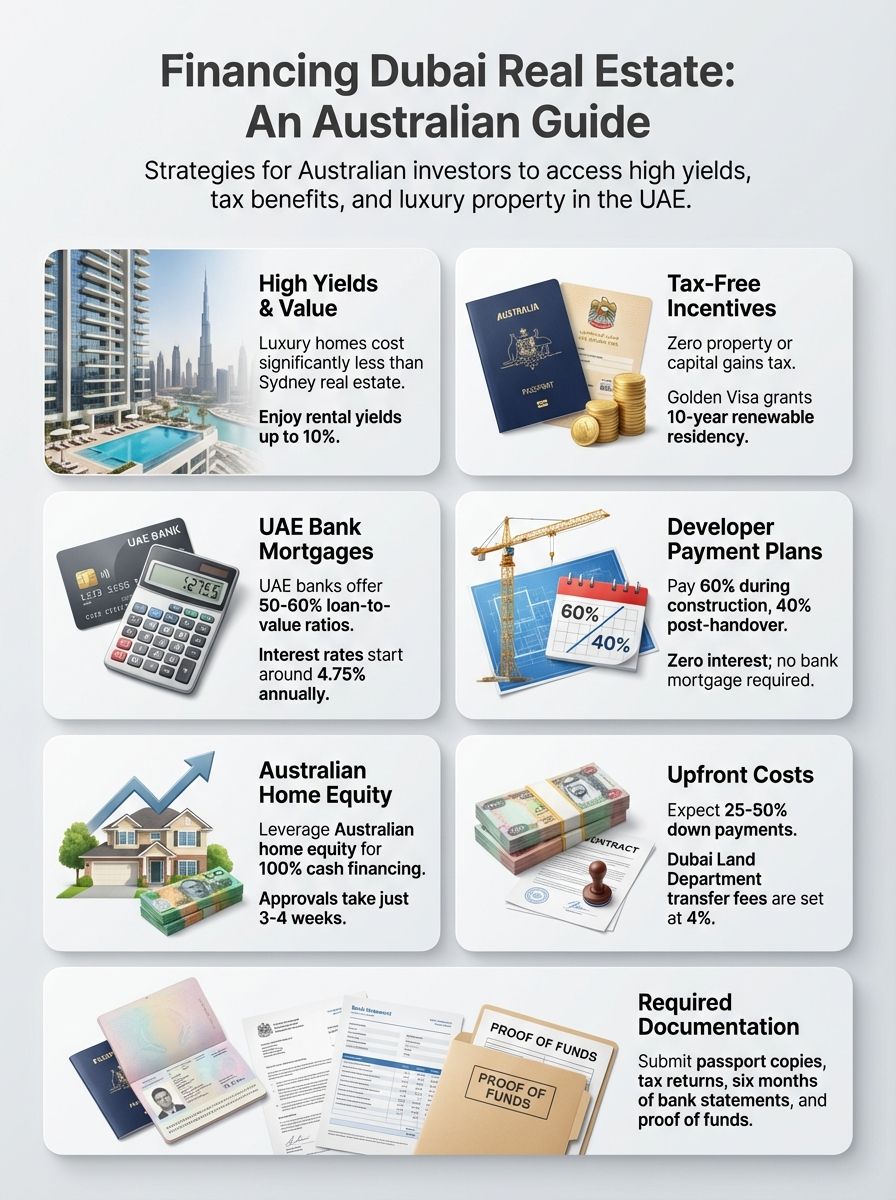
- Yield Disparity: Dubai properties average rental yields of 6–9% compared to Sydney’s 3–4% in 2025; luxury entry prices in Dubai are approximately USD 450,000 (AUD 690,000), significantly lower than comparable Australian markets.
- Mortgage Parameters: Non-resident mortgages from lenders like HSBC UAE or Emirates NBD are capped at 60% LTV, requiring a minimum 40% down payment, with interest rates typically ranging between 5.0% and 6.5%.
- Developer Financing: Major developers such as Danube and Damac offer post-handover payment plans, allowing buyers to pay up to 40% of the purchase price over 2–3 years after completion, effectively acting as interest-free leverage.
- Equity Strategy: Utilizing equity from Australian property via lenders like NAB or CBA allows investors to buy as “cash buyers” in Dubai, bypassing local mortgage processing times of 8–10 weeks.
- Upfront Capital: Investors must budget for purchase costs totaling roughly 6–7% of the property value, including the mandatory 4% Dubai Land Department (DLD) fee and 2% agency commission.
Reasons Australians Invest in Dubai Property
The primary driver for Australian capital moving to Dubai is the quantifiable difference in return on investment (ROI). While Australian markets offer stability, they are heavily taxed and capital-intensive. Dubai offers a contrasting value proposition centered on higher immediate cash flow and lower acquisition costs.
Secure your Dubai property finance with confidence.
We’ll guide you through every requirement step by step.
How affordable is Dubai property compared to Australian cities?

Dubai property functions as a value hedge against the inflated entry prices of Australian capital cities. For the price of a suburban unit in Sydney, investors can acquire premium inventory in global hubs like Downtown Dubai. 1
| Metric | Dubai (Prime) | Sydney (Prime) | Melbourne (Prime) |
|---|---|---|---|
| Entry Price (USD) | $490,000+ | $1,800,000+ | $1,000,000+ |
| Entry Price (AUD) | $760,000+ | $2,800,000+ | $1,540,000+ |
| Gross Rental Yield | 6% – 9% | 3.5% – 4.5% | 4.0% – 5.0% |
| Transaction Fees | ~6-7% (Total) | ~4-5% (Stamp Duty) | ~5.5% (Stamp Duty) |
The math creates a compelling business case. A property in Dubai priced at AUD 760,000 can generate approximately AUD 50,000 to AUD 60,000 in gross annual rent. A comparable investment in Sydney often yields less than AUD 30,000 while requiring a significantly higher mortgage commitment. This yield differential provides a buffer against currency fluctuations and global inflation.
Dubai property entry prices start from approximately USD 150,000-250,000 (AUD 230,000-385,000) for studios and one-bedroom apartments in prime areas like Dubai Marina, with luxury options available from USD 400,000-500,000.
What rental yields and tax benefits can investors expect?
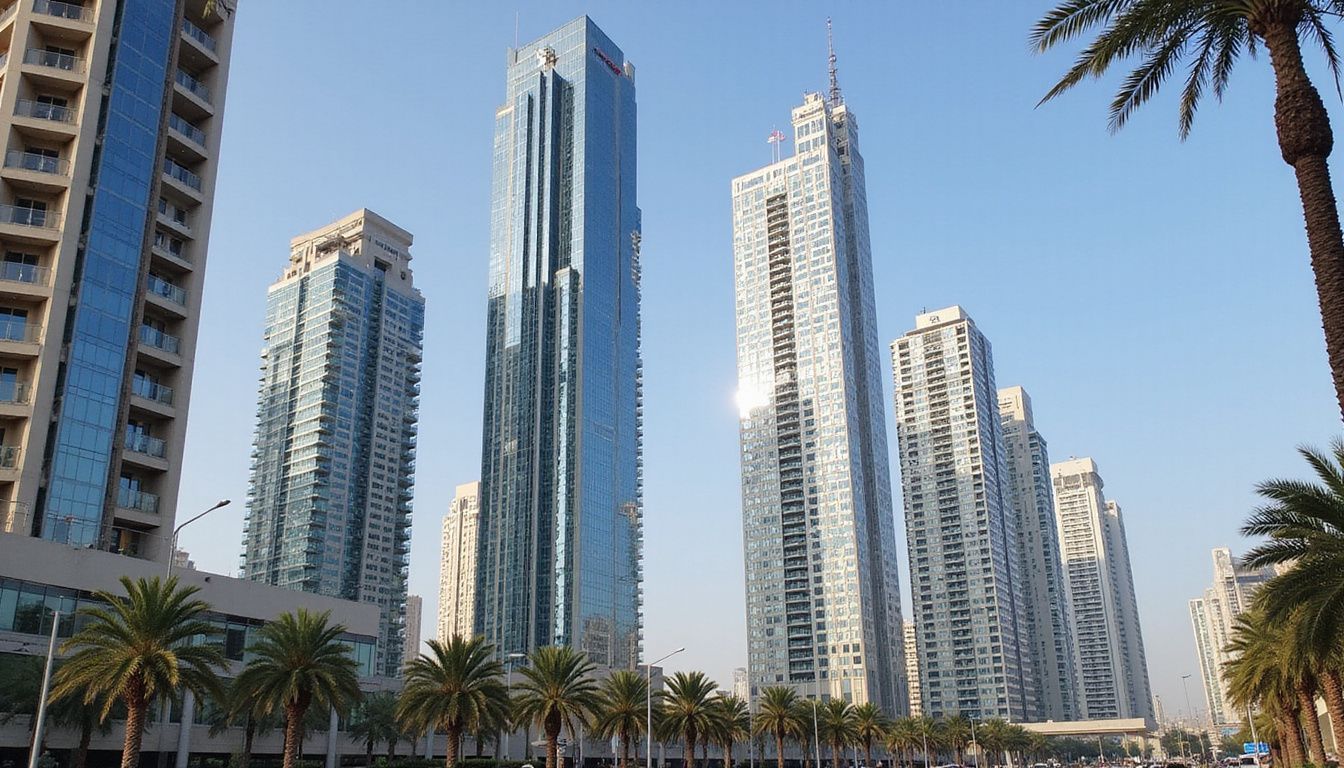
Dubai is a tax-neutral jurisdiction for property income, but Australian residents must navigate their domestic tax obligations carefully. The absence of local taxes in the UAE maximizes the gross revenue extracted from the asset.
Critical Tax Warning: While Dubai does not tax rental income, Australian tax residents are legally required to declare worldwide income to the ATO. Because you pay 0% tax in Dubai, you will not receive a Foreign Income Tax Offset (FITO), meaning the full income is taxed at your Australian marginal rate.
Despite this, the net result often outperforms Australian investments due to the absence of other ongoing levies.
- No Capital Gains Tax (UAE): Dubai does not levy capital gains tax on the sale of property, allowing investors to retain full equity growth upon exit (subject to Australian CGT rules).
- No Annual Property Tax: Unlike the council rates and land tax thresholds common in New South Wales or Victoria, Dubai imposes no recurring property tax.
- Currency Peg Stability: The UAE Dirham (AED) has been pegged to the US Dollar since 1997. This stability protects rental income from local currency volatility, though investors must still manage the AUD/USD exchange rate.
Ready to explore Dubai mortgage options?
Let’s break down your borrowing power clearly and simply.
What residency and lifestyle benefits come with investing?

Strategic investment in Dubai real estate unlocks residency options that serve as a “Plan B” for many high-net-worth individuals. Investing a minimum of AED 2 million (approx. AUD 850,000) qualifies owners for Dubai’s Golden Visa residency program.
This 10-year renewable visa covers the investor, their spouse, and children, operating independently of employment status. It provides the right to live, work, and study in the UAE, granting access to the country’s healthcare and education systems. For investors who do not wish to relocate, the visa facilitates unrestricted entry and exit, simplifying property management and banking logistics.
Ownership in freehold zones gives foreign investors 100% control of the asset. The Dubai Land Department regulates these titles, ensuring the same legal standing as local citizens. This transparency has made Dubai a preferred hub for global capital.
Financing Options for Australians in Dubai

Australian investors typically utilize three distinct channels to fund Dubai acquisitions: non-resident mortgages from UAE banks, developer-sponsored payment plans, or equity release from Australian assets. Each method carries a different risk profile and liquidity requirement.
Can Australians get non-resident mortgages from UAE banks?

Yes, but the terms are stricter than domestic Australian loans. UAE banks view non-residents as higher-risk borrowers, resulting in lower loan-to-value (LTV) ratios and slightly higher interest rates compared to resident financing.
- LTV Caps: The UAE Central Bank generally caps mortgages for non-residents at 50% – 60% of the property value. This forces a mandatory cash deposit of 40% – 50%, plus associated purchase costs.
- Interest Rates: As of 2025, variable rates for non-residents hover between 3.5% – 5.25%. Fixed-rate options are available, typically for 1-3 year terms, before reverting to a variable rate linked to EIBOR (Emirates Interbank Offered Rate).
- Key Lenders: Major institutions catering to Australian investors include HSBC UAE, Emirates NBD, and First Abu Dhabi Bank (FAB). Working with a specialist mortgage broker like BrandABC is often necessary to navigate the specific compliance requirements of these lenders.
- Income Verification: Banks require 6 months of Australian bank statements and proof of income. Self-employed applicants must provide audited company financials, which can extend the approval timeline to 8-10 weeks.
- Pre-Approval Importance: Due to the slow processing times, obtaining a pre-approval letter is critical before signing any Memorandum of Understanding (MOU) to avoid forfeiting your deposit.
For investors seeking to bypass bank scrutiny, developer financing offers a compelling alternative. Next, we examine how developer-backed post-handover payment plans function as a leverage tool.
Get matched with the right Dubai finance pathway.
We’ll help you move from enquiry to approval smoothly.
What are developer-backed post-handover payment plans?

Developer-backed payment plans are essentially interest-free loans provided directly by the builder. These plans are designed to stimulate sales in off-plan projects and are particularly popular among foreign investors who may struggle with local bank criteria.
These structures typically follow a “60/40” or “70/30” model. An investor pays 60% of the purchase price in installments during the construction phase. The remaining 40% is paid in monthly or quarterly installments after receiving the keys. Post-handover periods vary by developer: DAMAC typically offers 2-5 years, while Danube is known for extended plans of 8-10 years on select projects.
Strategic Advantages:
- No Interest Charges: Unlike a mortgage, the post-handover balance incurs 0% interest, significantly improving the net yield during the first few years of ownership.
- Rental Income Funding: Investors can rent out the property immediately upon handover and use the rental income to pay down the remaining post-handover installments.
- Simplified Access: There are no credit checks or extensive income verifications. Your passport and the initial down payment are usually sufficient to secure the contract.
Insider Tip: Be cautious of “1% Monthly Payment Plans” marketed by developers like Danube. While they offer incredible cash flow flexibility, the property price per square foot is sometimes inflated to offset the financing benefit. Always compare the total price against similar cash-only units in the area.
How can Australian home equity be used for Dubai property financing?
The most efficient method for many Australians is to unlock “lazy equity” from their domestic portfolio. By refinancing a property in Sydney or Melbourne, investors can draw down a line of credit or a lump sum to fund the Dubai purchase as a cash transaction.
Why Cash Status Matters:
In Dubai, cash buyers hold significant negotiation power. They can often secure discounts of 2% to 5% off the listing price because the seller knows there is no risk of bank rejection or valuation delays. This discount can effectively offset the Australian refinancing costs.
The Execution Strategy:
- Equity Release: Approach an Australian lender (e.g., CBA, NAB, Macquarie) to increase your loan against your Australian home. The funds are released in AUD.
- Currency Conversion: Use a specialized foreign exchange service (like OFX or Wise) rather than a bank transfer to convert AUD to AED (or USD). This can save up to 3% on exchange margins.
- Speed: Australian equity release takes 3-4 weeks. A Dubai mortgage takes 8-10 weeks. This speed allows you to snap up “distressed” deals that require quick settlement.
This strategy does introduce currency risk. If the Australian Dollar weakens significantly against the US Dollar (to which the AED is pegged), your debt in Australia remains constant while the asset value in AUD terms rises—but your repayment burden in local terms increases.
Take the guesswork out of Dubai property finance.
Our specialists help you understand costs, lending rules, and next steps.
Key Financing Considerations for Australian Investors

Beyond the purchase price, investors must account for the statutory costs of doing business in Dubai. The transaction ecosystem is transparent but front-loaded with fees that cannot be capitalized into the mortgage.
What are the down payment requirements and fees?

Liquidity is essential. Unlike Australia, where a 10% deposit might suffice, Dubai requires a substantial cash outlay upfront. 7 The table below outlines the mandatory capital requirements for a standard purchase.
| Fee Type | Amount | Recipient |
|---|---|---|
| Down Payment (Non-Resident) | 40% – 50% | Seller / Developer |
| DLD Transfer Fee | 4% of Purchase Price | Dubai Land Department |
| Trustee Registration Fee | AED 4,000 + VAT | Registration Trustee |
| Agency Commission | 2% + VAT | Real Estate Agent |
| Mortgage Registration Fee | 0.25% of Loan + AED 290 | Dubai Land Department |
| Oqood Fee (Off-Plan Only) | 4% of Purchase Price | Dubai Land Department |
For a property valued at AED 2 million, an investor needs approximately AED 930,000 (roughly AUD 395,000) in accessible cash to cover the 40% deposit and roughly 6.5% in total closing costs. BrandABC can assist in verifying these calculations before you commit to an offer.
What documentation is needed for financing?

The “Know Your Customer” (KYC) protocols in the UAE are rigorous. Whether applying for a bank loan or registering a cash purchase, specific documentation is non-negotiable.
- Identity: A valid passport with at least six months of validity remaining.
- Financials: Six months of original bank statements from your Australian account. Online printouts are often rejected; statements must be stamped by the bank or officially certified.
- Income Proof: Salaried employees need 3 months of payslips and a salary certificate. Self-employed investors must provide 2 years of audited financial statements.
- Credit Check: While the UAE has its own credit bureau (Al Etihad Credit Bureau), banks will request a copy of your Australian credit file to assess global liabilities.
- Property Documents: For the final transfer, you will need the original Title Deed (for resale) or the Oqood certificate (for off-plan), which BrandABC will help secure from the seller.
Discover the smartest way to finance your Dubai investment.
We’ll tailor a clear strategy based on your goals and budget.
Conclusion

Investing in Dubai property offers Australian buyers a strategic avenue to secure higher yields and currency diversification. The barriers to entry—specifically higher deposits and strict non-resident lending criteria—can be managed through careful planning and the right financing mix. Whether utilizing a 60% LTV mortgage from a UAE bank, leveraging a developer’s interest-free payment plan, or deploying Australian home equity, the options are robust.
Success requires accounting for the full spectrum of costs, including the 4% transfer fee and potential currency fluctuations. By engaging specialized guidance from BrandABC and ensuring all documentation is compliant, investors can confidently add high-performing Dubai assets to their portfolios.
Frequently Asked Questions About Financing Options For Australians Investing In Dubai Property
1. What financing options are available for Australian investors in the Dubai real estate market?
Australian investors can secure non-resident mortgages from major UAE banks like Emirates NBD and Mashreq, typically requiring a down payment of 40-50%. Alternatively, many buyers utilize post-handover payment plans from master developers such as Emaar, which allow you to pay a significant portion of the purchase price in interest-free installments after receiving the keys.
2. Are there property taxes or capital gains tax for Australians investing in off-plan properties in Dubai?
Dubai does not levy any annual property taxes or capital gains tax on real estate transactions. However, Australian tax residents are legally required to declare all worldwide income to the ATO, meaning any rental profits or capital gains from your Dubai assets must be reported on your Australian tax return.
3. How do mortgage registration fees work when buying apartments in Downtown Dubai or villas on Palm Jumeirah?
The Dubai Land Department charges a mandatory mortgage registration fee of exactly 0.25% of the registered loan amount plus a standard AED 290 administrative fee.
4. Can negative gearing be used by Australians with investment properties in Dubai?
Yes, Australian tax residents can generally offset net rental losses from their Dubai property against their domestic Australian income, such as salary or wages. You must maintain precise records of all expenses and convert these figures into Australian dollars to substantiate your claim with the ATO.
5. Do cookies or digital tools help Australian buyers compare refinance deals across different areas like Dubai Marina and Palm Jumeirah?
Specialized comparison platforms like Mortgage Finder and Yallacompare are the most effective tools for evaluating non-resident lending rates across different districts. These sites aggregate current market data to help you secure competitive offers for properties in prime locations like Downtown Dubai or the Marina.
References
- ^ https://www.dubayt.ae/blog-details/10-reasons-why-australians-should-buy-property-in-dubai
- ^ https://wise.com/us/blog/getting-a-mortgage-in-dubai
- ^ https://www.engelvoelkers.com/ae/en/resources/post-handover-payment-plan-dubai
- ^ https://propertyupdate.com.au/an-australians-guide-to-financing-a-dubai-property-purchase-and-top-neighborhoods/ (2024-08-23)
- ^ https://www.jarniascyril.com/international-real-estate/invest-in-australian-real-estate/get-real-estate-financing-australia/
Usable Sources
Australian Property Market:
- Savings.com.au – NSW Rental Yields
- Wise – Best Rental Yield Australia 2025
- OpenAgent – Suburbs with Highest Rental Yield
- Global Property Guide – Australian Rental Yields
Dubai Property Market & Yields:
- Wise – Dubai Rental Yield
- Engel & Völkers – Rental Yield Dubai
- Driven Properties – Dubai Highest Rental Yield Locations
- Dar Global – Dubai Real Estate ROI 2025
Dubai Property Prices:
- Dubai Homes Online – Property Price in Dubai
- Investasian – Dubai House Cost
- Driven Properties – Average House Price in Dubai
- Metropolitan Real Estate – Dubai Marina
Non-Resident Mortgages:
- Capital Zone – LTV Ratio for Non-Resident Mortgage
- Tranio – Mortgage in Dubai for Non-Residents
- Svarn Development – Dubai Mortgage Rates Expats 2025
- Engel & Völkers – Dubai Mortgage for Non-Residents
- Sands of Wealth – Dubai Mortgages for Non-Residents
- Wise – Getting a Mortgage in Dubai
- Expatica – Mortgages in UAE
Tax Information for Australians:
- Dubai Invest – Tax Advantages for Australian Investors
- Titan Wealth – Australian Working in Dubai Tax
- Atlas Wealth – Tax Residency for Australian Expats in UAE
- ATO – Rental Properties 2025
Golden Visa:
- Dubai Land Department – Golden Visa Investor
- UAE Government – Golden Visa
- Henley Global – UAE Residence by Investment
- Immigrant Invest – UAE Golden Visa
DLD Fees & Transaction Costs:
- Engel & Völkers – DLD Fees
- Sands of Wealth – Dubai DLD Fee When Buying
- West Gate Dubai – Dubai Property Fees 2025
- Homeland Realty – Property Ownership Transfer Fee 2025
Currency Peg:
- The National – UAE Dirham Dollar Peg
- MyDay Finance – USD-AED Peg Analysis
- Wikipedia – United Arab Emirates Dirham
Developer Payment Plans:
- LYM Real Estate – Post-Handover Payment Plans
- Engel & Völkers – Post-Handover Payment Plan Dubai
- APIL Properties – Best Payment Plans to Buy Dubai Property
- Haus and Estates – Dubai Off-Plan Payment Plans
- DAMAC Properties – Payment Plan Breakdown
Market Trends & Analysis:
- Deloitte – Dubai Real Estate Predictions 2025
- Emaar – Dubai Real Estate Trends 2025
- Global Property Guide – UAE Price History
Disclaimer: All information provided by Dubai Property for Aussies (DPA) is for educational and informational purposes only. It should not be considered financial, legal, or investment advice.
DPA does not offer professional advisory services. We strongly encourage users to seek independent financial or legal guidance before making any property-related or investment decisions.