🎧 Listen to this article in podcast style
▶ Breaking News — May 2026
UAE Confirms Etihad Rail Passenger Launch in 2026 & Awards $8 Billion High-Speed Rail Contracts — Dubai and Abu Dhabi Property Markets on Notice
UAE Infrastructure & Property Investment 2026
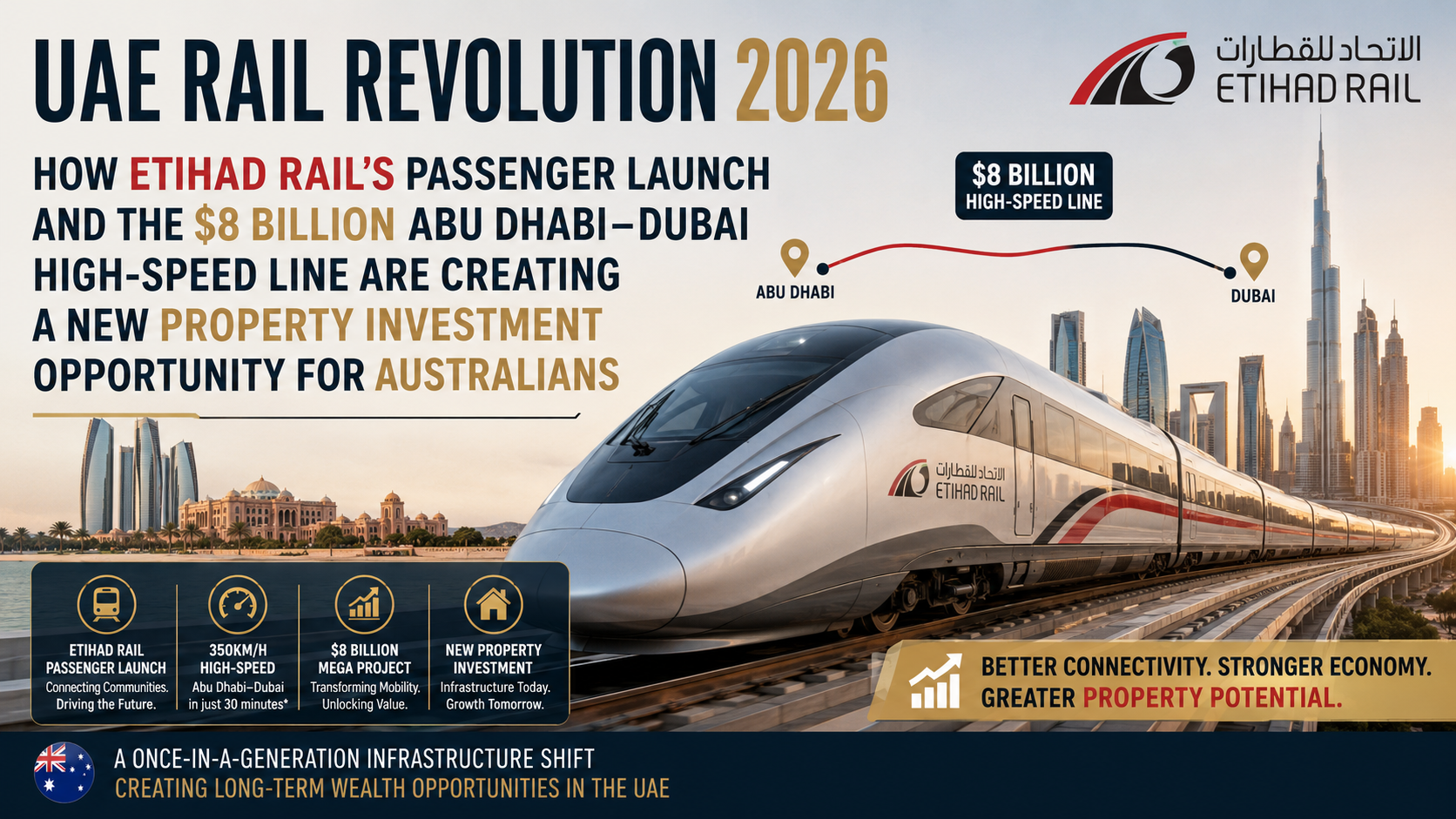
UAE Rail Revolution 2026: How Etihad Rail’s Passenger Launch and the $8 Billion Abu Dhabi–Dubai High-Speed Line Are Creating a New Property Investment Opportunity for Australians
The UAE is transforming how it moves between its cities — and for Australian property investors watching Dubai and Abu Dhabi, two landmark rail projects now underway represent the most significant infrastructure-driven property opportunity in the region’s history. Etihad Rail is weeks from launching phased passenger services in 2026. Simultaneously, an $8 billion high-speed line will link Abu Dhabi and Dubai in 30 minutes by 2030. Together, they are rewriting the investment map for both emirates.
By Dubai Property for Aussies | Published May 2026 | 16-minute read

Etihad Rail 2026 Passenger Launch: What Australian Property Investors Need to Know First
After years as a freight-only backbone, Etihad Rail is now confirmed to carry passengers across the UAE in a phased rollout beginning in 2026 — marking the birth of the nation’s first fully integrated national passenger railway. Route selection for the first phase is based on population density, commuter demand and connectivity priorities: the Abu Dhabi–Dubai–Fujairah corridor.
Ten of the 13 trains in the fleet have already arrived in the UAE, tested and certified to international safety standards. Each train carries up to 400 passengers across three classes — Economy, Family and First Class — and is managed by the UAE’s most advanced rail operations systems. The full Etihad Rail network will connect 11 cities and regions spanning 900 kilometres, with the operator projecting 36.5 million passengers annually by 2030.
Why 2026 Is the Critical Window for Dubai & Abu Dhabi Property Investors
Rail infrastructure is one of the most reliable property price catalysts in any real estate market. The pattern — confirmed in London, Sydney, Singapore and Hong Kong — is consistent: values near confirmed stations begin moving ahead of launch, peak in the 12–36 months following service commencement, and then stabilise at a new, higher baseline. Properties near Etihad Rail stations in Dubai and Abu Dhabi are already recording average price growth of 9% over the past nine months. For Australian investors considering Dubai and Abu Dhabi property, the 2026 window — before the trains actually run — is precisely where the best early-mover gains are made.
The Second Rail Story: $8 Billion High-Speed Contracts Awarded for Abu Dhabi–Dubai Line
Running in parallel, and arguably more transformative in its implications, Etihad Rail has awarded over $8 billion in design-and-build contracts for a completely separate ultra-high-speed rail line between Abu Dhabi and Dubai. This 150-kilometre Phase 1 line is designed for a maximum speed of 350 km/h, with an operating speed of 320 km/h — targeting a 30-minute journey between the two cities. Completion is set for 2030. For investors, this means that from 2030, Dubai and Abu Dhabi will effectively function as a single, seamlessly connected metropolitan investment zone.
▶ Key Takeaways
- ✔Etihad Rail launches phased passenger services in 2026, connecting Abu Dhabi, Dubai and Fujairah from the outset
- ✔Dubai to Abu Dhabi: 57 minutes on Etihad Rail; a separate $8 billion high-speed line cuts that to 30 minutes by 2030
- ✔Two confirmed Dubai Etihad Rail stations: Jumeirah Golf Estates and Dubai South (adjacent to Al Maktoum International Airport)
- ✔Five high-speed line stations including Abu Dhabi International Airport, Yas Island, Saadiyat and Al-Jaddaf (Dubai terminal)
- ✔Properties near confirmed rail stations are already averaging 9% price growth — with zero capital gains tax and no land tax on all UAE property
- ✔The rail connection makes Abu Dhabi viable as a standalone investment target for Australians — not just Dubai
- ✔Australian investors can access confirmed rail-corridor apartments from approximately AUD 294,000 in Dubai South
Is Your Dubai Investment in the Path of the UAE Rail Boom?
Confirmed stations at Jumeirah Golf Estates and Dubai South are already recording 9% price growth — and Abu Dhabi’s Yas Island and Saadiyat stations go live by 2030. Our team can identify which rail-corridor properties match your budget and timeline before the trains start running.
➡ Check Which Rail Zone Fits Your BudgetEtihad Rail vs. Abu Dhabi–Dubai High-Speed Rail: Two Projects, One Powerful Property Opportunity
Media coverage of UAE rail often conflates these two distinct projects. For property investors, understanding the difference is critical — they have different timelines, different station locations, and different implications for which suburb you should target.
Project 1: Etihad Rail Passenger Network — Launching 2026, 11 Cities, 900 km
Etihad Rail is the UAE’s national railway, built on existing freight infrastructure and now extending to passenger service. Phase 1 of the passenger rollout runs Abu Dhabi–Dubai–Fujairah, with further cities and regions added in subsequent phases. It is a conventional intercity passenger service — think interstate rail — connecting cities with platform stops rather than urban metro frequency. Abu Dhabi to Dubai: 57 minutes. Abu Dhabi to Fujairah: 1 hour 45 minutes.
Ticket classes include Economy (face-to-face seating), Family (opposing seats, larger table) and First Class (wider adjustable seats). Estimated Economy fares for Dubai–Abu Dhabi are AED 50–75 one-way (approximately AUD 21–31), though official prices have not been released at the time of writing.
Project 2: Abu Dhabi–Dubai Ultra-High-Speed Rail — 350 km/h, 30 Minutes, Completing 2030
This is a greenfield $8 billion project — an entirely new, dedicated high-speed line with no relationship to the existing Etihad Rail freight network. Phase 1 covers 150 kilometres from Al-Zahiyah (central Abu Dhabi, underground) to Al-Jaddaf (central Dubai, underground), with five stations total: Al-Zahiyah, Saadiyat Island, Yas Island, Abu Dhabi International Airport and Al-Jaddaf in Dubai.
Contracts for the Abu Dhabi section were awarded to a consortium of National Projects Construction, Trojan Tunnelling, Kalyon (Turkey) and China State Construction Engineering Corporation. The Dubai section went to Larsen & Toubro (India) as lead contractor, with China Harbour Engineering, Wade Adams, Egis (France) and Surbana Jurong. The line is designed for 350 km/h maximum speed, with operating speed of 320 km/h. Journey time between Yas Island and Al-Jaddaf: approximately 30 minutes.
| Feature | Etihad Rail (Passenger) 2026 | Abu Dhabi–Dubai High-Speed Rail 2030 |
|---|---|---|
| Launch / completion | 2026 phased launch | 2030 targeted completion |
| Network type | National intercity passenger rail | Dedicated ultra-high-speed line |
| Route length | 900 km national network | 150 km Phase 1 (Abu Dhabi – Dubai) |
| Dubai–Abu Dhabi journey | 57 minutes | 30 minutes |
| Maximum speed | Conventional intercity | 350 km/h |
| Dubai station(s) | Jumeirah Golf Estates; Dubai South | Al-Jaddaf (underground, central Dubai) |
| Abu Dhabi station(s) | Abu Dhabi city station; further cities TBA | Al-Zahiyah, Saadiyat, Yas Island, Abu Dhabi Airport |
| Capacity per train | 400 passengers | High-capacity (TBC) |
| Estimated fare (economy) | AED 50–75 Dubai–Abu Dhabi (est.) | Not yet announced |
| Construction status | Infrastructure complete; service imminent | $8 billion contracts awarded, building begun |
| Property impact timeline | Now — ahead of 2026 launch | From 2027–28 as construction progresses toward 2030 |
Which UAE Rail Zone Matches Your Property Investment Budget?
Dubai South entries from AUD 294,000 (Etihad Rail 2026) and Yas Island from AUD 462,000 (high-speed rail 2030) — our team can walk you through which rail corridor stacks up best for your goals and risk profile.
➡ Find My Dubai or Abu Dhabi Rail Zone PropertyDubai Etihad Rail Station Locations 2026: Your Property Investment Map
Station location is everything in rail-driven property investment. For Australians assessing the opportunity, here is a precise breakdown of every Dubai stop — what it is, where it sits in the market, and what the Dubai property investment numbers look like for each precinct.
Jumeirah Golf Estates Station — Etihad Rail, Dubai (2026): Premium Rail Corridor Investment
Dubai’s primary Etihad Rail passenger station is located within Jumeirah Golf Estates (JGE), a master-planned luxury residential community in the southern part of the city, positioned along Sheikh Mohammed Bin Zayed Road. JGE is already one of Dubai’s most prestigious villa and apartment communities, home to PGA-standard golf courses and hosting the DP World Tour Championship annually.
Entry-level apartments at JGE start at approximately AED 1.35 million (AUD 567,000), with townhouses averaging AED 6.87 million and premium villas reaching AED 33 million-plus. Despite its prestige, rental yields at JGE run at 7–8% — high for a community at this level. For AED/AUD yield modelling, see our Dubai property ROI guide for Australian investors.
Dubai South Station — Etihad Rail, Adjacent to Al Maktoum International Airport (2026): Best Entry Point for Australians
Dubai South is the second confirmed Etihad Rail Dubai station — and the most accessible entry point for Australian investors. Apartments are available from approximately AED 700,000 (AUD 294,000), with an average asking price of AED 1,230 per square foot. Rental yields run consistently at 7–8%, driven by Expo City Dubai, Al Maktoum Airport expansion and now the confirmed 2026 rail station.
Dubai South is a UAE 2040 Urban Master Plan priority corridor — designated as one of the emirate’s primary future urban growth zones. In terms of structural drivers, it is arguably the most multi-layered investment case in Dubai right now: airport expansion, rail launch, Expo City catchment, and a government-backed master plan all pointing in the same direction.
Al-Jaddaf Station — High-Speed Line Dubai Terminal (2030): Early-Mover Capital Growth Play
Al-Jaddaf, located east of Business Bay and minutes from Downtown Dubai, will be the Dubai terminus of the Abu Dhabi–Dubai high-speed line — an underground station integrating with existing metro connections. The inner-city location, combined with the prestige of a high-speed rail terminal, is already attracting investor interest.
Apartments in Al-Jaddaf are currently priced below Business Bay and Downtown Dubai, making it an early-mover opportunity for investors who want high-speed rail terminus proximity without paying the Downtown premium. Analysts are projecting 5–10% price appreciation in the precinct as construction becomes visible through 2027–28.

UAE Rail Impact on Dubai Property Investment for Australians: The Numbers Behind the Story
Australians understand rail-driven property booms better than most. The extension of Sydney’s metro network, Melbourne’s Suburban Rail Loop and Brisbane’s Cross River Rail all created measurable price uplift in the corridors they serve. Dubai is about to experience a version of exactly this dynamic — but with one critical advantage for overseas investors: zero capital gains tax, zero annual property tax and no stamp duty on any Dubai or Abu Dhabi property purchase.
Rail Proximity Premium: What the Global Data Says for Dubai 2026
Globally, properties within 500 metres of a new rail station outperform the surrounding market by 10–15% in sale price and 8–12% in rental income within three to five years of service commencement. London’s Elizabeth Line (Crossrail) delivered 23% excess appreciation near stations over five years. Melbourne’s rail extensions created consistent double-digit premiums in commuter belt suburbs. In Dubai, analysts are projecting 10–25% station-proximity appreciation once Etihad Rail passenger services begin, and 20–30% across the 2027–2030 window for high-speed line precincts.
Crucially, Dubai’s starting yield position makes the compounding effect even more powerful. While Sydney or Melbourne rail corridor properties might deliver 3–4% gross yield and 10% capital uplift, Dubai South offers 7–8% gross yield and similar or greater capital uplift potential — from a base price of approximately AUD 294,000. The risk-adjusted case for Australian investors is difficult to ignore.
“Connectivity is the single biggest driver of rental demand. When a suburb shifts from ‘far from the city’ to ‘on the rail line’, everything changes — rents move, vacancy falls, and capital values follow. In Dubai, that shift is happening now.”— Property market commentary, Arabian Business, 2026
Currency Advantage: Why the AED Peg Benefits Australian Investors
The AED has been pegged to the USD at AED 3.67 = USD 1.00 since 1997 — providing a stable currency baseline that is unusual in emerging market real estate. With the Australian dollar currently purchasing approximately AED 2.38, Dubai South apartments at AED 700,000 translate to roughly AUD 294,000. Your only currency exposure is the AUD/USD rate, which moves like any standard Australian international currency dynamic — familiar territory for Australians with overseas exposure.
Abu Dhabi Property Investment 2026: How the UAE Rail Network Unlocks a Whole New Market for Australians
Here is a dimension of the UAE rail story that most commentary overlooks: the passenger rail launch and the high-speed line do not just make Dubai more investable — they make Abu Dhabi investable from Dubai, and vice versa. For Australian investors, the rail connection creates an entirely new layer of investment strategy: buying in Abu Dhabi while maintaining a Dubai-based lifestyle and tenant pool, or holding assets across both emirates as a single interconnected market.
Abu Dhabi as a Standalone Investment Destination: Why Rail Changes the Equation
Until now, Abu Dhabi has been a separate calculation for most Australian investors — a different city, a different market dynamic, a different commute. The 57-minute Etihad Rail connection (and eventually 30-minute high-speed service) fundamentally changes this. A tenant who works in Dubai can now realistically live in an Abu Dhabi property. A tenant who works in Abu Dhabi can realistically live in Dubai. The two cities are becoming, for practical rental purposes, a single market.
Abu Dhabi offers property prices that are in many precincts lower than equivalent Dubai areas, with rental yields that are competitive — typically 6–7% gross across key investment suburbs. Abu Dhabi also has its own Golden Visa property threshold (AED 2 million), a zero-tax framework identical to Dubai, and all the lifestyle and infrastructure advantages that make the UAE compelling for Australian investors.
Yas Island, Abu Dhabi — High-Speed Rail Hub by 2030: Leisure, Retail & Capital Growth
Yas Island is one of Abu Dhabi’s premier entertainment and residential destinations — home to Ferrari World, Yas Waterworld, Yas Marina Circuit and a growing number of luxury residential communities. It is also confirmed as a station on the Abu Dhabi–Dubai high-speed rail line, with an at-grade station that will directly serve the island’s resident and visitor population.
Yas Island apartments are currently available from approximately AED 1.1 million (AUD 462,000), with rental yields averaging 6–7%. The combination of the island’s established leisure economy, the confirmed high-speed rail station and the UAE’s broader tourism growth trajectory makes Yas a compelling medium-term capital growth play for Australian investors with a 2028–2032 horizon.
Saadiyat Island, Abu Dhabi — Culture, Luxury and a Future High-Speed Rail Station
Saadiyat Island is Abu Dhabi’s cultural flagship — home to the Louvre Abu Dhabi, the Guggenheim Abu Dhabi (under construction), the upcoming Natural History Museum and an expanding collection of luxury residential communities. A confirmed elevated station on the high-speed rail line will serve the island, making it accessible to Dubai in under 30 minutes by 2030.
Saadiyat commands premium pricing — villa and townhouse entries typically start at AED 3–4 million — but yields remain solid at 5–7% depending on property type. For Australian investors targeting capital-heavy, long-hold plays in globally recognised cultural precincts, Saadiyat offers a unique combination of prestige, yield and infrastructure-driven capital growth that is hard to replicate anywhere else in the region.
Abu Dhabi vs. Dubai: Which Rail Market Suits Which Australian Investor?
| Investor Profile | Better Fit: Dubai Rail Corridor | Better Fit: Abu Dhabi Rail Corridor |
|---|---|---|
| Entry budget | AUD 294,000+ (Dubai South) | AUD 462,000+ (Yas Island) |
| Yield priority | Dubai South, JGE — 7–8% | Yas Island — 6–7% |
| Capital growth focus | Al-Jaddaf (high-speed 2030) | Saadiyat & Yas Island (high-speed 2030) |
| Timeline | Immediate (Etihad Rail 2026) | Medium-term (high-speed 2030) |
| Tenant market depth | Very deep — 3.7M Dubai population | Strong — 1.5M Abu Dhabi population |
| Airport proximity | Dubai South: adjacent to Al Maktoum Airport | Yas Island: adjacent to Abu Dhabi Airport station |
| Golden Visa threshold | AED 2M property value | AED 2M property value |
| Zero CGT | Yes — UAE-wide | Yes — UAE-wide |

Ready to Invest Across the Dubai–Abu Dhabi Rail Corridor?
Dubai South yields 7–8% from AUD 294,000. Yas Island offers capital growth from AUD 462,000 with a confirmed high-speed station by 2030. Our team can help you build a cross-corridor strategy that maximises both yield and capital growth — across both emirates.
➡ Enquire About Dubai & Abu Dhabi Rail Zone PropertiesBest Dubai & Abu Dhabi Rail Corridor Investment Areas 2026: Yields, Entry Prices & Outlook for Australian Buyers
Not all rail proximity is equal. Based on confirmed station locations and current market data, here is how the key UAE rail corridor precincts compare. For deeper per-suburb analysis including historical yield data, see our Dubai and Abu Dhabi property market analysis for Australians.
| Area & Emirate | Confirmed Station | Entry Price (AED) | Entry Price (AUD approx.) | Gross Yield | Rail Service & Year | Investor Outlook |
|---|---|---|---|---|---|---|
| Dubai South, Dubai | Etihad Rail 2026 | AED 700,000+ | AUD 294,000+ | 7–8% | Etihad Rail 2026 | ★★★★★ Best entry value |
| Jumeirah Golf Estates, Dubai | Etihad Rail 2026 | AED 1.35M+ | AUD 567,000+ | 7–8% | Etihad Rail 2026 | ★★★★★ Premium lifestyle |
| Al-Jaddaf, Dubai | High-Speed 2030 | AED 900,000+ | AUD 378,000+ | 6–7% | High-Speed Rail 2030 | ★★★★ Early-mover growth |
| Yas Island, Abu Dhabi | High-Speed 2030 | AED 1.1M+ | AUD 462,000+ | 6–7% | High-Speed Rail 2030 | ★★★★ Leisure & airport hub |
| Saadiyat Island, Abu Dhabi | High-Speed 2030 | AED 3M+ | AUD 1.26M+ | 5–7% | High-Speed Rail 2030 | ★★★★ Prestige capital growth |
| Fujairah City, Fujairah | Etihad Rail 2026 | AED 500,000+ | AUD 210,000+ | 6–7% | Etihad Rail 2026 | ★★★ Emerging market |
How Australian Investors Buy Dubai & Abu Dhabi Rail Corridor Property: Step-by-Step Guide 2026
Buying property in Dubai or Abu Dhabi as an Australian is a streamlined process once you understand the framework. Both emirates allow Australian nationals to hold full freehold title in designated freehold areas — which include every rail corridor precinct discussed in this article. There is no visa requirement to buy, no restriction on repatriating rental income and no CGT in the UAE when you sell.
- 1Define your rail corridor strategy. Decide whether you want the near-term yield story of Dubai South or JGE (Etihad Rail, 2026), the inner-city capital growth play of Al-Jaddaf (high-speed, 2030), or the cross-emirate diversification of Yas Island or Saadiyat (Abu Dhabi, high-speed 2030). Each has a different capital requirement and risk profile.
- 2Engage a licensed Dubai or Abu Dhabi broker. Work with a broker who understands the Australian investor context: AUD/AED currency modelling, Australian tax treatment of overseas income, and the specific off-plan versus ready-property dynamics in each rail precinct.
- 3Confirm freehold eligibility for your chosen property. All rail corridor precincts discussed in this article are designated freehold areas. Your broker will verify freehold eligibility and that the developer or seller holds a valid DLD or Abu Dhabi Department of Municipalities registration.
- 4Sign the Sales and Purchase Agreement (SPA). The SPA locks in your price and terms. Off-plan purchases typically require a 10–20% deposit, with the balance payable in construction-linked instalments. Ready properties require full settlement, often with 30–60 days for funds transfer from Australia.
- 5Register with the Dubai Land Department (DLD) or Abu Dhabi equivalent. All property transfers must be registered with the relevant authority. The registration fee is 4% of purchase price in Dubai (paid once at transfer). Abu Dhabi charges 2% on transfers. No annual stamp duty, no land tax, no CGT when you sell in either emirate.
- 6Set up rental management and EJARI registration. Appoint a local property manager to handle tenancy agreements, EJARI (rental registry) registration, rent collection and any maintenance. Most Australian investors manage this entirely remotely. Rental income in AED is typically transferred to an Australian bank account quarterly.
Finance & Tax for Australian Buyers: Maximising Returns in the UAE Rail Corridor
UAE Tax Environment: Zero CGT, Zero Land Tax, Zero Annual Property Tax
One of the most compelling dimensions of the UAE rail investment opportunity is the tax environment. Dubai and Abu Dhabi property sits in a zero-tax framework that is rare anywhere in the world. There is no capital gains tax when you sell. No annual property tax. No council rates equivalent. No land tax. The only transactional cost is the one-time 4% DLD registration fee in Dubai (2% in Abu Dhabi) on purchase.
Australian Tax Obligations on UAE Rental Income
Australian residents are taxed on worldwide income, so rental income from a Dubai or Abu Dhabi property must be declared to the ATO. Because the UAE levies no tax on this income, there is no foreign tax credit to offset — you pay Australian marginal rates on net rental profit after allowable deductions (interest, depreciation, management fees, travel). Many Australian investors structure ownership via individual name, SMSF (Self-Managed Super Fund) structures or discretionary trusts to optimise their after-tax position. Always seek advice from an Australian tax adviser with international property experience.
On capital gains: Australian CGT applies when you sell, with a 50% discount for assets held more than 12 months. The zero UAE CGT means there is no foreign tax credit to apply against your Australian liability. Structuring the ownership correctly from the outset is important.
Mortgage and Finance Options for Australians Buying Dubai Rail Zone Property
Australian residents can obtain mortgages from UAE banks for Dubai property, though eligibility criteria are stricter for non-residents than for UAE residents. Most Australian investors buying off-plan use the developer’s payment plan (typically 10–20% deposit, balance in construction instalments) rather than a mortgage, as this avoids UAE mortgage qualification requirements and allows Australian equity or savings to fund the purchase progressively.
Loan-to-value ratios for non-residents in UAE banks are typically capped at 50% of property value for ready properties. Interest rates for non-resident mortgages from UAE banks have historically tracked 0.5–1.5% above UAE resident rates. For more on how the numbers stack up, see our complete Dubai property ROI and finance guide for Australian investors.
Frequently Asked Questions: UAE Rail, Dubai & Abu Dhabi Property Investment for Australians 2026
When exactly does Etihad Rail passenger service launch in 2026?
Etihad Rail has confirmed a phased passenger launch in 2026, with the initial phase covering the Abu Dhabi–Dubai–Fujairah route. Commercial services are expected to begin in Q2 2026. A nationwide rail safety campaign launched in May 2026 is part of the pre-launch preparation, with 10 of 13 trains already delivered, tested and certified to international safety standards.
Are the Etihad Rail network and the Abu Dhabi–Dubai high-speed line the same project?
No — they are entirely separate projects. Etihad Rail is the national freight-turned-passenger railway launching in 2026, with stations at Jumeirah Golf Estates and Dubai South in Dubai. The Abu Dhabi–Dubai high-speed line is a new $8 billion greenfield project with contracts awarded and a 2030 target completion, with five stations including Yas Island, Saadiyat, Abu Dhabi Airport and Al-Jaddaf in Dubai.
Can I buy in Abu Dhabi as an Australian investor?
Yes. Abu Dhabi has designated freehold areas where Australian nationals can purchase full freehold title, including Yas Island and Saadiyat Island — both confirmed high-speed rail stations. The UAE-wide zero CGT and zero land tax framework applies in Abu Dhabi exactly as it does in Dubai. Abu Dhabi property registration attracts a 2% transfer fee (versus 4% in Dubai).
Which rail corridor area is best value for Australians in 2026?
For entry-level value and near-term yield, Dubai South stands out: apartments from AED 700,000 (approximately AUD 294,000), 7–8% gross yield, confirmed 2026 rail station and multiple structural growth drivers including Al Maktoum Airport expansion. For premium lifestyle and equivalent yield, Jumeirah Golf Estates offers a compelling case. For medium-term capital growth, Al-Jaddaf (Dubai high-speed 2030) and Yas Island (Abu Dhabi high-speed 2030) are the early-mover plays.
Is there a minimum property value to qualify for a UAE Golden Visa via rail corridor properties?
Yes. The UAE Golden Visa property investment threshold is AED 2 million (approximately AUD 840,000). Properties in Jumeirah Golf Estates and Yas Island can reach this threshold, making them eligible as Golden Visa investment vehicles. Dubai South and Al-Jaddaf apartments below AED 2 million would not qualify on their own for the Golden Visa, though they remain strong investment assets independent of visa considerations.
How do I repatriate rental income from Dubai to Australia?
There are no UAE restrictions on repatriating funds from Dubai or Abu Dhabi to Australia. Rental income in AED is collected by your property manager and can be transferred to your Australian bank account at any time. You use a currency transfer service (such as Wise, OFX or your bank) to convert AED to AUD. The AED/USD peg means your AED income is effectively USD-based, with only the AUD/USD rate as your variable.
Can Australians obtain a UAE mortgage for a rail corridor property?
Yes, though criteria for non-residents are stricter than for UAE residents. Most Australian investors in off-plan rail corridor properties use developer payment plans (10–20% deposit, balance in construction instalments) rather than bank mortgages. For ready properties, UAE banks offer non-resident mortgages at up to 50% LTV. Speak to your broker about which financing structure is most appropriate for your chosen precinct.

Dubai & Abu Dhabi Property Market Outlook 2026–2030: The Rail Decade Begins
The Pre-Launch Window: When Rail Investors Make Their Best Returns
Global evidence on rail-driven property uplift is consistent across markets: the strongest returns go to investors who buy before the trains run, not after. London’s Elizabeth Line saw station-adjacent properties appreciate 23% more than the wider London market in the five years surrounding opening. Singapore’s MRT extensions have delivered consistent 15–20% premiums in new station precincts. Melbourne’s Cranbourne-Pakenham rail corridor created sustained uplift for investors who moved ahead of electrification. Dubai in 2026 and Abu Dhabi targeting 2030 are precisely at this pre-launch inflection point.
What Happens After the Trains Start Running: The 2026–2030 Property Forecast
Independent analysts are projecting 10–25% capital appreciation near confirmed Etihad Rail stations once 2026 passenger services begin — layered on top of the 9% already recorded in the past nine months. In the 2027–2030 window, high-speed line precincts (Al-Jaddaf in Dubai, Yas Island and Saadiyat in Abu Dhabi) are forecast to see a further 20–30% uplift as construction visibility increases and the launch date becomes tangible.
The broader Dubai and Abu Dhabi market context is equally favourable. Dubai real estate recorded double-digit price growth for the third consecutive year in 2025, with Australian buyer enquiries increasing significantly. Rental demand is underpinned by a growing expat workforce, strong tourism numbers and the UAE’s continued positioning as a global business hub. Rail adds a structural, infrastructure-driven layer to what was already a compelling yield-and-growth story. Stay up to date with the latest Dubai and Abu Dhabi property news to track this market as the launch approaches.
Risk Factors Australian Investors Should Consider
Rail-adjacent property is not universally positive. Properties very close to surface-level rail alignments may face noise and vibration impacts during construction and operations — underground stations (Al-Jaddaf, Al-Zahiyah) avoid this issue. Station precincts can also take years to fully mature as retail, dining and amenity catchments develop around them. Construction delays are a risk in all infrastructure projects of this scale. Currency fluctuation between AED/USD and AUD adds a layer of return variability. Always inspect the specific property position relative to the rail alignment — not just the general suburb — and stress-test your investment against a 12–24 month construction delay.
The Bottom Line: UAE Rail Is the Biggest Property Investment Catalyst in Dubai and Abu Dhabi Right Now
The UAE’s rail revolution is not speculation — it is confirmed infrastructure with contracts awarded, trains delivered, safety campaigns running and a timetable locked in. For Australian investors working with our team, the combination of rail-driven demand uplift, Dubai and Abu Dhabi’s zero-tax property framework and yields that still double most Australian capital city equivalents makes the current window unusually compelling.
Dubai South is the accessible entry point for Australians: from AUD 294,000, 7–8% gross yield, a confirmed 2026 rail station and multiple structural growth drivers. Jumeirah Golf Estates is the premium lifestyle play. Al-Jaddaf is the patient capital growth strategy for the high-speed terminus. And Abu Dhabi’s Yas Island and Saadiyat bring a whole new emirate into the investable universe — made accessible by the 30-minute high-speed connection arriving by 2030.
In every case, the time to position is before the trains start running — not after the ribbon is cut. History consistently rewards early movers in rail-driven property markets. The UAE is giving investors the rarest of gifts: full visibility on the timeline and station locations, well ahead of launch. The opportunity to act on that visibility closes fast.
Lock In Your UAE Rail Zone Property Before Full Service Begins
Etihad Rail passenger services are launching in 2026 and $8 billion in high-speed rail contracts are already awarded. Rail corridor properties in Dubai and Abu Dhabi will reprice when the trains run. Our team is ready to help you identify the right precinct, property and structure — in both emirates.
➡ Start Your Dubai or Abu Dhabi Rail Zone InvestmentSources & Further Reading
- Gulf News — Etihad Rail to launch phased passenger services in 2026
- Etihad Rail Official — UAE Full Passenger Railway Network details
- Engineering News-Record — UAE Signs First Contract for $8B High-Speed Rail Project
- Railway Pro — USD 8 billion in the Abu Dhabi–Dubai high-speed line
- The National News — Etihad Rail announces 30-minute high-speed passenger service between Abu Dhabi and Dubai
- Khaleej Times — How Etihad Rail will reshape UAE property markets
- Digital Dubai — Etihad Rail 2026: Station guide, ticket prices and property investment impact
- Engel & Völkers UAE — Average Rental Yields in Dubai 2026 Market Insights
- Arabian Business — Etihad Rail launches nationwide UAE safety campaign
- Milestone Homes RE — Etihad Rail Dubai real estate impact, property prices and growth